StrykerLabs GmbH · Graz
Wearable Dashboard
A health dashboard for wearable data, built in collaboration with StrykerLabs GmbH, Graz. Heart rate, sleep, and activity — cleanly visualised in a medical-grade interface.

At a glance
- Institute
- eHealth, FH JOANNEUM Graz
- Partner
- Strykerlabs GmbH
- Supervisor
- DI Dr. Markus Bödenler, BSc
- Team
- Christian Briegler, Hannes Dieter, Patrick Hennes, Alexander Taupe
- Period
- 10/2025 to 02/2026
My role
Garmin integration and integration dashboard
The problem
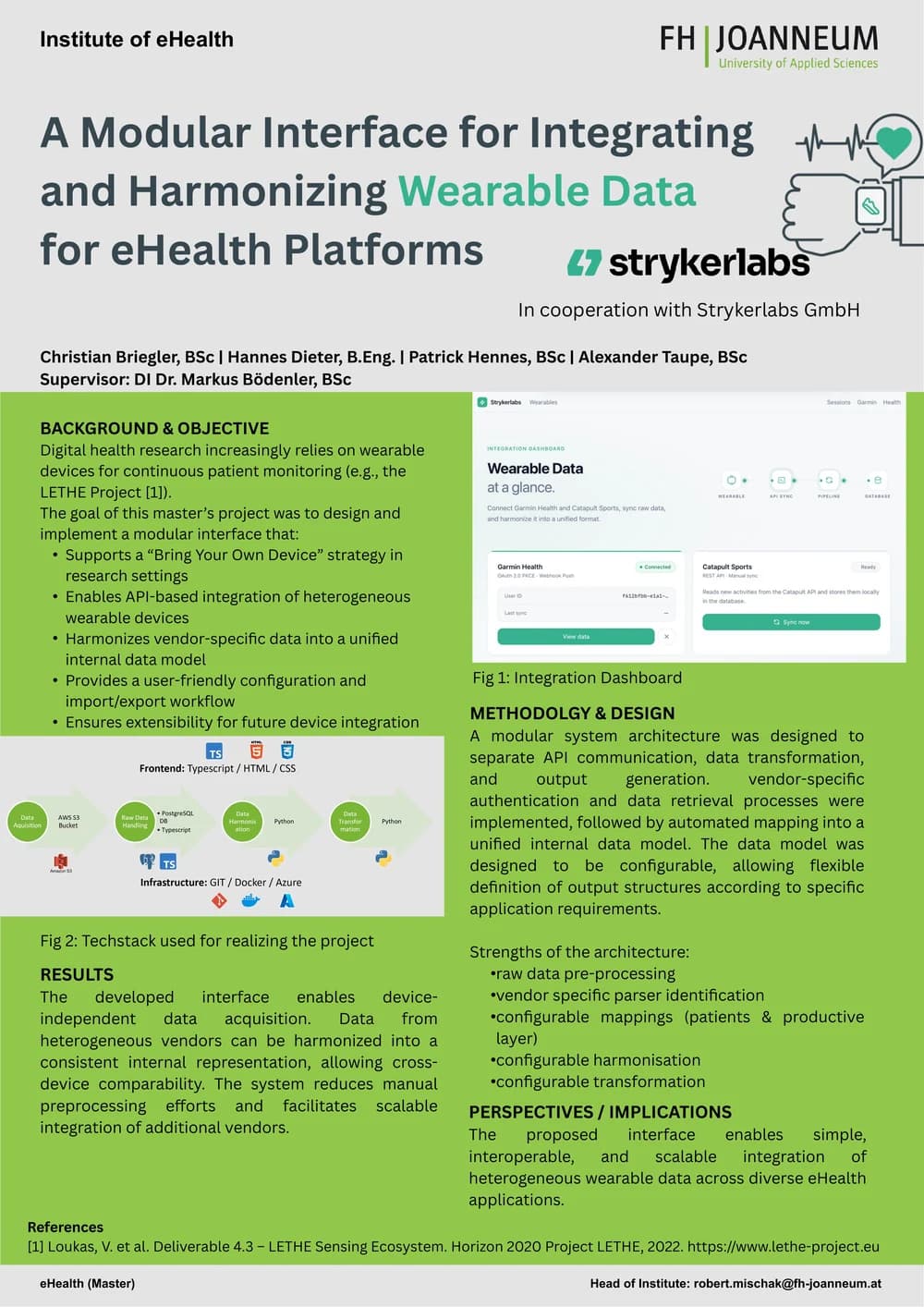
Digital health research increasingly relies on wearables for continuous monitoring, as in the EU LETHE project. That runs into a practical wall: participants own different devices, every vendor exposes a different API, and every vendor returns a different shape of data. The alternative is handing every participant the same watch, which is expensive and changes behaviour.
How it works
- I connected the Garmin Health API end to end: the OAuth 2.0 PKCE authorisation flow, and real-time webhook push ingestion rather than polling. Garmin sends data when it has data, which means the interface has to accept and validate a payload it did not ask for, at a moment it did not choose.
- I built the integration dashboard: connection state per vendor, session browsing and the configuration surface.
- The architecture separates API communication, data transformation and output generation, so adding a vendor does not mean rewriting the pipeline.
- Data harmonisation, the Catapult integration and the backend pipeline were built by other members of the team.
Stack
TypeScript, HTML and CSS on the frontend. PostgreSQL for raw data handling, Python for harmonisation and transformation, AWS S3 for data acquisition, Git, Docker and Azure for infrastructure.
Outcome
The interface enables device-independent data acquisition. Data from different vendors ends up in a consistent internal representation, which makes it comparable across devices, reduces manual preprocessing, and lets further vendors be added without touching what already works. Published by FH JOANNEUM.